The Re-Yodeling of Yahoo: How Emmy Morton is Modernizing an Enduring Brand

For Emmy Morton, Head of Creative at Yahoo, leadership is environmental; it is about creating the conditions where good ideas can happen. Images c/o Yahoo.
The Most Useful Peer Network for Creative Professionals
Creative Factory is a private, highly-vetted leadership community for brand leaders. Join peers from Netflix, Meta, Amazon, Roblox, and more.
Did you know that roughly 90% of the U.S. internet population visits Yahoo each month? Yes, that Yahoo.
Behind that staggering stat is a business currently having a major moment, powered by a modern brand refresh that balances decades of internet legacy with a playful, self-aware new energy. At the center of this evolution is Emmy Morton, Head of Creative, who oversees the company’s internal creative studio. Rather than treating Yahoo’s massive utility as just numbers on a screen, Morton’s team treats every click as an opportunity to build emotional resonance.
By bridging the gap between business scale and cultural relevance, she is proving that a legendary brand doesn’t need to reinvent its personality to feel completely fresh today. But modernizing an icon requires more than just a sharp design system; it demands a distinct kind of leadership.
Here, Morton shares her definitive principles for creative leadership built on her evolution from a hands-on graphic designer to an executive driving horizontal corporate strategy, and her conviction that “leaders set the weather” for their teams.
Brand, Business, and Modernizing an Icon
How do you define the role of creativity in a tech company like Yahoo, especially when dealing with products that people use out of utility?
Our work is rooted in the belief that creativity is what makes useful things worth caring about. There are a lot of products that work, but the ones people remember are the ones with emotional resonance.
In practice, that means we look to connect our work to the moments shaping culture. We build systems and campaigns that help us feel distinct as one of the world’s most enduring brands. A huge part of that work right now is helping Yahoo feel like itself again in a modern way.
What does that look like?
Yahoo has always had recognizable symbols with our tone of voice, the color purple, and the yodel. Our challenge isn’t inventing a personality from scratch; it’s bringing that personality forward in a way that feels current, playful, and self-aware.
We are executing this across products. Our recent brand refresh reimagined Yahoo through a modern design system while protecting what people already love.
Our refreshed look and feel can also be seen and felt in our marketing, like our “Cardi B Busy” campaign, which marked the launch of Planner in Yahoo Mail. Planner transforms your inbox into a personal productivity hub by taking all of the life admin often buried in emails and adding them directly to an integrated calendar and to-do list. For the campaign, we tapped into a very human tension, FOMSI (Fear of Missing Something Important). Casting Cardi B helped bring that to life. She represents that level of nonstop activity in a way that makes the idea immediately clear and culturally relevant.
The campaign hones in on that highly relatable chaos of everyday life. Just this week alone, my child had to wear neon to school and it was game day, so we had to find a game to send in. We turned that everyday parental tension into something fun and emotionally believable.

In their recent Cardi B campaign, Yahoo tapped into a very human tension, FOMSI (Fear of Missing Something Important). Cardi would never.
What recent work best captures this new direction?
Another example is when we leaned into the shared experience of inbox overload with “YaHoHoHo,” a campaign starring Dylan Efron as Santa, built around the idea that no one has a busier inbox than Santa, and how Yahoo Mail features like package tracking can help. We based “Crush Your Day,” a campaign starring Frankie Muniz to launch our new daily puzzle game Crushable, on the idea that people like to kick off their morning with a quick game and the small, satisfying win that comes with it.
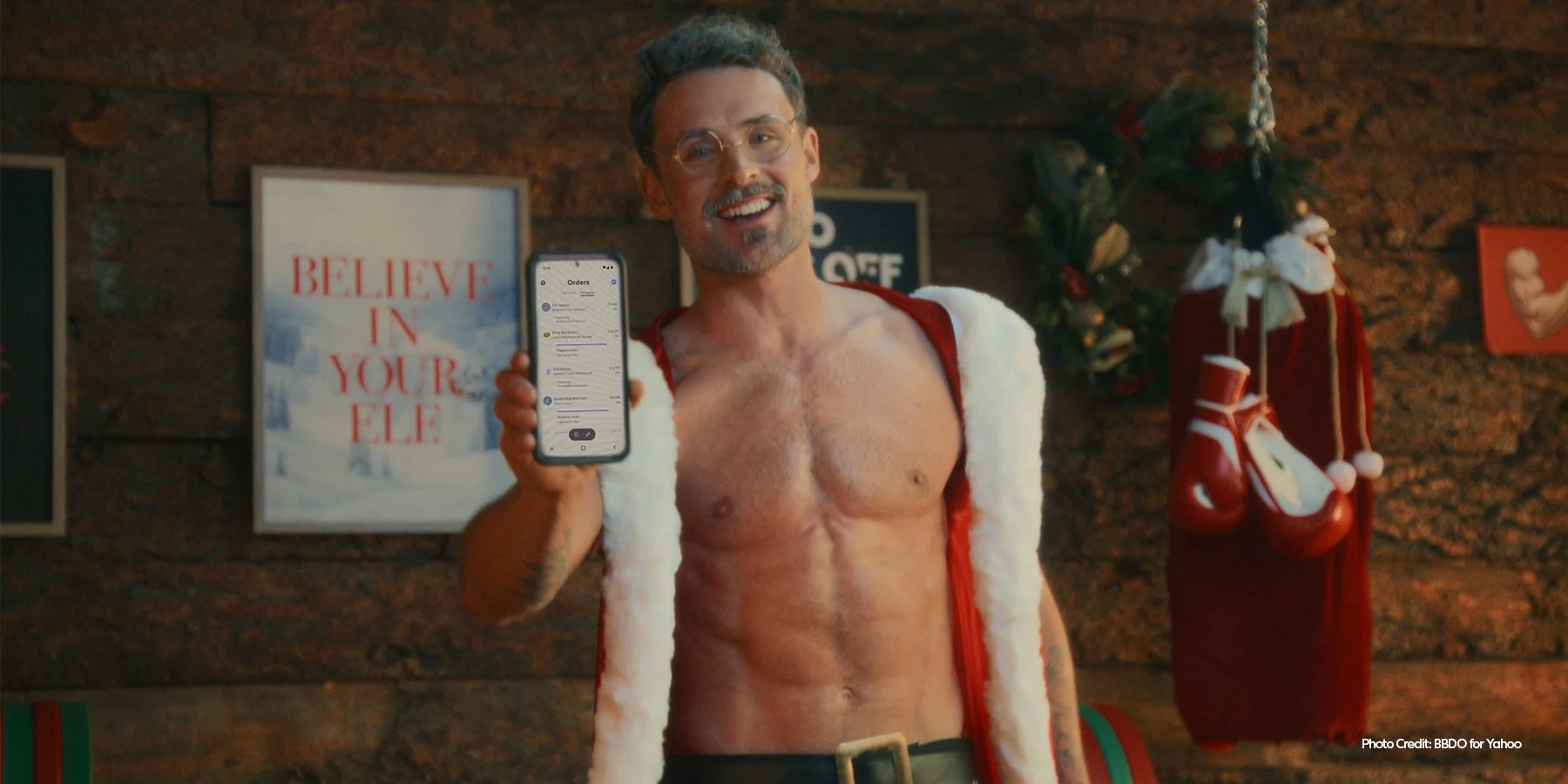
Santa's showing up a bit different this year in the recent “YaHoHoHo” campaign.
The Engine: Team Structure and Leadership Philosophy
How is your team structured, and where does it fit within the company?
Our internal creative studio is tight-knit, around 30 people. We tap into a pool of contractors for different skill sets and specialties, and we work closely with vendors and agencies to help us scale across different workstreams.
We are positioned as a horizontal team, and we work across all of Yahoo. I love the opportunity to touch a lot of different audiences, products, and insights. I have creative directors focused on specific verticals so they can be deeply embedded in the work.
We hear a lot about the coach-player leadership model these days. What does leadership look like for you?
Leadership is environmental; I see my job as creating the conditions where good ideas can happen. That means providing clarity, building trust, and protecting people from unnecessary chaos. I never want our environment to feel fear-based, because the best work doesn’t come from that.
I also believe clarity is kindness. The clearer I can be about direction, the more freedom people actually have to create. I’m also big on setting high standards and “catching” people doing things right. Standards become culture when you consistently reinforce them.
As you rose in your career from full-time producer to creative executive, what did you learn while developing your leadership style?
The biggest realization was that creative direction and creative leadership are not the same thing. When you transition into leadership, your job isn’t just having ideas anymore. It’s about creating clarity, managing energy, and helping people do their best thinking together.
Anything else?
I’ve gained a deep awareness of energy. Early in my career, I was entirely focused on the work, ideas, and momentum. I didn’t fully recognize how much leaders “set the weather.” Teams observe far more from you than your explicit intent. They read your tone, reactions, and what you choose to celebrate. All of that shapes the culture.
Where do you most get hands-on in the work?
We have a daily, hour-long creative review every afternoon. It’s structured around keeping the work alive, discussing the concepts, and keeping the team connected in a remote culture. Creativity needs oxygen, and so does the team.
I’m always involved upfront. Then, depending on the priority and tier of the project, I lean in and out. I want my team to drive the work. I will shape it along the way, but I never want them to just execute my version of it. I want them to have true ownership.
Creativity as a Worldview
What are your earliest creative memories?
Creativity was always how I moved through the world. My mom was a teacher, and I have vivid childhood memories of designing things. Creativity never felt separate from real life; it was how we communicated, solved problems, and made things better. It’s a lens I’ve never turned off.
Did you always know that communicating visually was going to be your career path?
Yes, I took a graphic design class in high school, and the memory of that studio is burned into my brain. It had the iconic color iMacs. I was learning early Adobe Illustrator, and it was the first time I had the revelation that ideas and instinct could actually become a career.
From there, I went to Towson. It isn’t a traditional art or portfolio school, but in retrospect, that gave me a broader relationship to creativity. I’ve always been interested in design, but I’ve also been equally interested in people, culture, communication, and building a full life. That background helped my career become much broader than design itself.
Moving Up, Winding Down, and Looking Ahead
What does your creative life look like when you’re off the clock?
Our house is constantly full of creativity; it’s an innate part of how I live my life with my husband and children. For me, staying refreshed comes down to constant observation. Even when I’m completely unplugged and watching a show on Netflix, I’m looking at how a sequence was shot or how an intro was put together. I look at fashion, internet culture, and how brands are activating at events like Coachella.
You can absorb inspiration from everything around you, whether it’s an illustration on a menu or a handmade sign at a local farmer’s market.
What advice would you pass on to creative directors who aspire to become executive leaders in large-scale companies?
Learning to read the room is vital, especially in a remote world. You have to listen to what is not being said on video calls.
And build an environment where people can tell you the truth. I want to know when something isn’t working, when a team is stuck, or when they think we’re heading in the wrong direction. If people are just “managing up” to you instead of being honest, you lose so much valuable insight.
What’s the biggest challenge for you on the horizon?
Ultimately, the challenge we are solving is continuing Yahoo's evolution from a brand that people remember fondly into one that people feel actively connected to today. Yahoo has always had deep humanity and personality. Our opportunity is to ensure that distinct voice comes through in everything we make. For a creative team, that is an incredibly invigorating gift of a brief.

Join more than 50 leaders from top organizations, including Amazon, Netflix, Meta, Shake Shack, NASA, Hearst, Roblox, United Airlines, and Instacart.